
Circular Mission
Circular Economy & Sustainability Solutions
Circular by Design
At United, we make circular simple. Our closed-loop sustainability and circular economy solutions help our clients divert more, recover more, and landfill less.
Whether you’re managing dry waste, liquid waste, packaged wastes, hard-to-recycle materials, or byproducts with energy value, United makes circular economy solutions simple.
Circular Economy & Sustainability Solutions
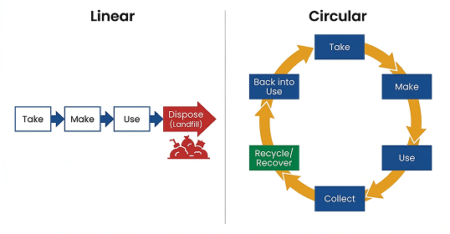
United helps food and beverage manufacturers transition from a “take-make-dispose” mindset to circular, accountable waste programs that reduce landfill reliance, protect your brand, and create usable reporting for sustainability goals
Circular Economy Explained
Circular economy is a practical way to keep materials in use longer instead of sending them to landfill after one pass through your operation. For industrial teams, that means deciding what can be recycled, what can be recovered, and what needs a defined non-landfill pathway.

Why Circular Economy Matters
- It can lower disposal and material costs by recovering value from material that would otherwise be thrown away.
- It supports sustainability and compliance reporting by creating clearer tracking for diversion, recovery, and material outcomes.
- It reduces landfill and environmental impact by keeping more material in productive use through recycling and recovery.
How Circular Economy Works
A circular economy works best when each material stream has a clear path from use to reuse, recycling, or recovery.
- Design for Recovery: Plan for reuse or recycling before materials become waste.
- Make / Process: Materials move through production with fewer loss points and clearer handling rules.
- Use: Products and packaging serve their intended purpose, then get captured instead of discarded.
- Collect + Separate: A repeatable sorting workflow protects recovery value and reduces contamination.
- Recycle High-Value Streams: Viable materials move into recycling pathways that keep value in circulation.
- Recover the Rest (Non-Landfill): When recycling is not viable, materials move to recovery options that reduce landfill dependence.
Linear vs. Circular
How United Supports Circular Economy Models
Circularity does not happen because a policy says so. It happens when you have a repeatable plan for every stream: what can be recycled, what can be recovered, and what must be handled securely.
Waste Stream Assessment
We evaluate what you generate, how you store it, how it moves, and where value is being lost, then build a program your team can actually run.
Recycling That's Built for Industrial Reality
When recycling is viable, we route materials into recycling pathways designed for high-volume operations.
Zero-Landfill Pathways for Mixed and Non-Recyclable Materials
Circular economy programs break when "the rest" still goes to landfill. United's zero-landfill approach combines structured recycling with non-landfill alternatives for non-recyclable materials.
Waste-to-Energy Alternatives (When Recycling Isn't Viable)
Some waste streams cannot be recycled economically or consistently. In those cases, waste-to-energy alternatives help close the loop and reduce landfill dependence.
Brand Protection and Secure Handling
For IP-sensitive, off-spec, expired, or customer-returned materials, United supports secure handling workflows such as documented destruction and witnessed processes where required.
One Partner Instead of a Patchwork of Vendors
If you're managing multiple streams, dry waste, liquids, packaged goods, or hard-to-recycle materials, United consolidates the program into one end-to-end strategy.
What We Track + Report
Sustainability claims do not hold up without documentation. United supports clients with reporting that helps you show landfill diversion progress and material outcomes.
Quarterly Reporting Can Include:
- Tonnage volumes by recyclable material, such as metal, cardboard, and plastic
- Recovered and re-deployed nutrient value
- Volumes routed to non-landfill alternatives, such as engineered fuel pathways when applicable
- Program-level progress you can share internally and with customers